
June Newsletter
THRILL ME by Benjamin Percy and Why I Love Backstory

I remember several years ago when I started to write seriously, encountering the popular notion that backstory must be limited, layered in precise details that say just enough to let the reader piece together the rest. This bothered me, as I love backstory. One of my favorite books is Nick’s Trip, by George Pelecanos, and a huge portion of that novel is flashback. I love backstories in movies, too. Reservoir Dogs and The Godfather Part II come to mind.
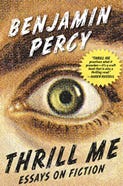
This idea came into focus recently as I read Thrill Me, by Benjamin Percy, a GREAT addition to the genre of essays about writing fiction. I believe the choices authors make to organize plot, write dialogue, create setting, and build character are as important as the prose, and I’ll listen to suggestions from any writer, before dismissing them or adding them to my repertoire of moves. However, a percentage of books on writing are didactic nightmares, boring reads where maybe one in five pages sparks something in me.
Thrill Me is different.
It’s got helpful suggestions, with examples from short stories and novels to explain, but what I like most is how the author keeps it entertaining, which is kind of his thesis statement (and the point of the book. It’s called Thrill Me, duh).
Even when I disagree with one of Percy’s ideas, I still agree with it.
For example, Percy gets “irritated by backstory,” and says it isn’t necessary because a reader, “intuits the history of a character by observing them acting in the present” (89).
People are like this, right?
Watching others, judging. And we assign meaning to everything.
You meet the new guy at work and instantly ‘know’ he’s the type to get a little defensive when challenged, or when your friend doesn’t answer a text message, you ‘know’ she’s ignoring you—again. It’s how the brain works. It makes connections, we choose a narrative, and then fit the pieces together like evidence to support a story we believe.
Percy also claims stories are about “forward movement,” and “backstory goes on and on until we forget about the dramatic present (90),” but I’m not sure that’s true. I think a good story is about solving the mystery, even in literary fiction or sci-fi or fantasy or romance. The excitement comes from searching for understanding that explains why a character does something, and in that searching we want to watch and see what happens next. We want the solution to the mystery. Backstory provides some of that evidence. And to say a reader will forget about the present moment is a stretch.
Percy goes on to say, “if used sparingly… backstory can have a propulsive force” (93), and provides this example as proof:
Let’s say your character, Burt, runs a coffee shop and one day a girl walks in off the street. She appears homeless: her clothes are secondhand, her backpack is greasy and bulging. She waits in line and when it’s her turn, she simply stands there, trembling. Burt says, “What would you like? A hot chocolate maybe?” But she’s not there for a drink. She’s there to identify Burt as her father. End scene. You are following several points of view in this novel, so when you cut to a new chapter, it’s a new perspective. We’re left hanging, wondering what the hell happened in the coffee shop. When we finally return to Burt, he’s at home with his very pregnant wife. Their marriage is on the rocks. They’re expecting their first child. And now he has to tell her about the girl in the coffee shop. He won’t know for sure until he takes a paternity test, but the girl’s story checks out: her mother is an addict he had a fling with a decade ago. You see—the scene is rolling forward with great tension, and the tension is made that much worse because we still don’t know what happened in the coffee shop. Now you deliver the backstory.
Burt laughs at the girl, asks her if this is her idea of a joke, a way to score a free snack, and only when she begins to cry does he notice their eyes are the same shade of blue-green and he walks around the counter and ushers her to a table with a cookie and a lemonade and spends the next twenty minutes speaking to her in a hushed voice and finally promises that if what she says is true, he will take care of her. The backstory, sandwiched into the scene with his wife, compounds the pressure.
This is a great example of backstory, no doubt, and I think it proves my point. What creates the tension is the audience searching for clues to solve the mystery of the scenes. Who is the girl? Is Burt really her father? It’s just good storytelling.
Percy ends his essay with the following line: “In other words, never use backstory—except when it works.”
Two ideas can be true at the same time, and here, that bears considering. Backstory can become annoying, tedious, and it can kill forward momentum, or it can provide the evidence a reader/ viewer needs to ramp up tension and piece together a compelling mystery. It’s all about how an author uses it.
Updates
- I’ll be at Chapters/ Indigo on Saturday, June 20th from 1:00 to 3:00 signing copies of THE BROKEN DETECTIVE. If you’re in Winnipeg, come on out and say hi.
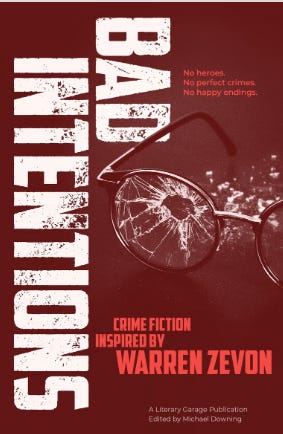
- The short story anthology BAD INTENTIONS comes out on July 7th, fifteen stories all related to the music of Warren Zevon. My story, “Oil in the Bones,” was lucky enough to make it in. I’ll have more information, including how to buy a copy, in my July newsletter.
Thanks for reading!
Joel
I like backstory! I like in medias res, too.
It's all about proportion and pacing.
I’m with you on backstory. I think it gets a bad rap because it is overused in literary fiction. I just read an arc of Bad Intentions. Wow that collection packs a punch and I loved your story. Doing an interview with Zakariah and Michael about in July.