
The Process
Control what you can, then let the rest go.

The term the process gets tossed around, and when I was young, I didn’t like it. I just showed up, played the sport or wrote the test. I wasn’t a fan of calling anything a process because it sounded so fake, as if you could follow a clear set of instructions to determine the outcome you desired.
Now, though, I love the term. It spells out in two words ideas that I believe in. Namely, the idea that doing the right things raises the chances of success.
On May 14th to 16th, my son’s spring hockey team (2016 birthdays) played in a tournament in Calgary. I’d describe us as a team that relies on everyone to win, rather than two or three stars. We lost the first two games in the tournament, then won four in a row on route to the gold medal and a tournament victory, beating a team that whooped us in the round robin.
Throughout the spring season, and especially during this final tournament, us coaches spoke time and time again about being hard to play against, the power of working hard, keeping the legs going, and having each other’s backs in difficult moments.
The boys weren’t always able to do these things (They’re 9 and 10!), but they were when it counted most. I’m proud of them.
I was watching the teams warm up before the semi-final game, and as stupid as it sounds, it dawned on me that I had absolutely no impact on the outcome of the game. Sure, I could correct mistakes, make suggestions, and perhaps make a rousing speech. I could bring the energy and attitude I wanted the team to have. But I couldn’t pass or shoot a puck. I couldn’t check hard or make a great save. I found this realization comforting, and one I can use in my writing life.
As writers, we spend hundreds of hours writing, then send the work to an agent or publisher, and wait for weeks or months to get a response. During this time, I often feel like there’s more I can do or should have done, and the waiting can make even the strongest stoic anxious. It sort of feels like I’m standing on a bench during a game, in limbo, hoping the players perform and make the right choices. That they execute. It’s much healthier to prep your team and accept whatever happens. As for writing, once you’ve submitted, there’s nothing you can do.
You’ve come up with an idea, maybe outlined. You’ve created characters, a setting, and written a compelling story. You’ve cut and added and revised and polished and stressed over words and phrases and punctuation and plot points and character arcs.
But after it goes out, it’s best to forget about it and trust the process.
Writing Updates
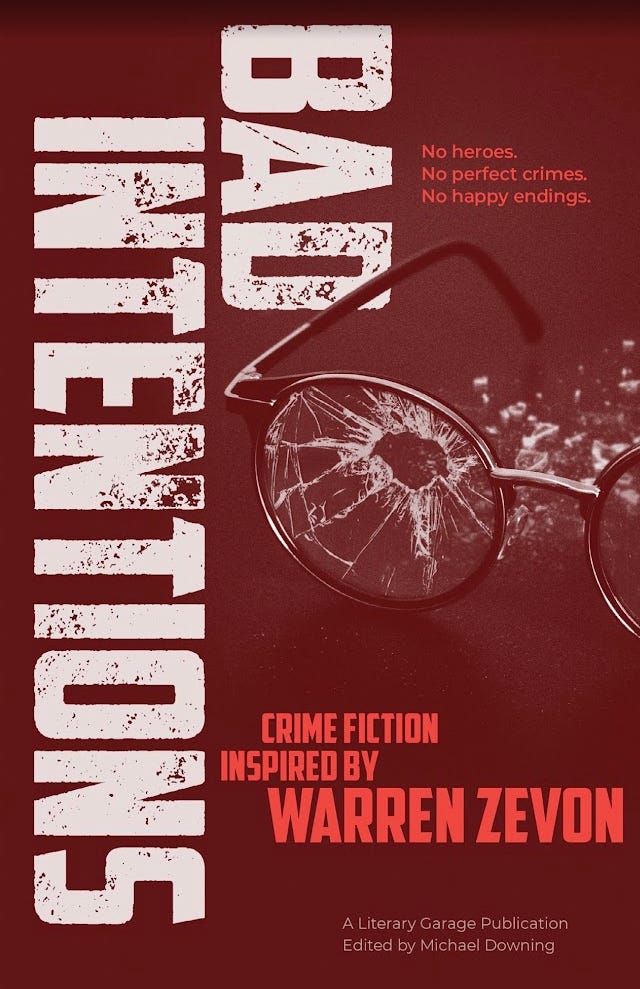
- My short story, “Oil in the Bones,” about a retired hockey player who robs a drug cartel, will be included in BAD INTENTIONS, an anthology of stories based on the music of Warren Zevon, published by Literary Garage on July 7th, 2026. More info to come close to release day! Here is the cover:
- I’ve just finished a short story for a Christmas anthology called CRIME FOR CHRISTMAS, published by ReBound Press. My understanding is this one will be out in November in preparation for the holiday season.
Hope everyone is well, and thanks for reading.
Joel
Congratulations Joel!